.png)

Quick-Read Summary
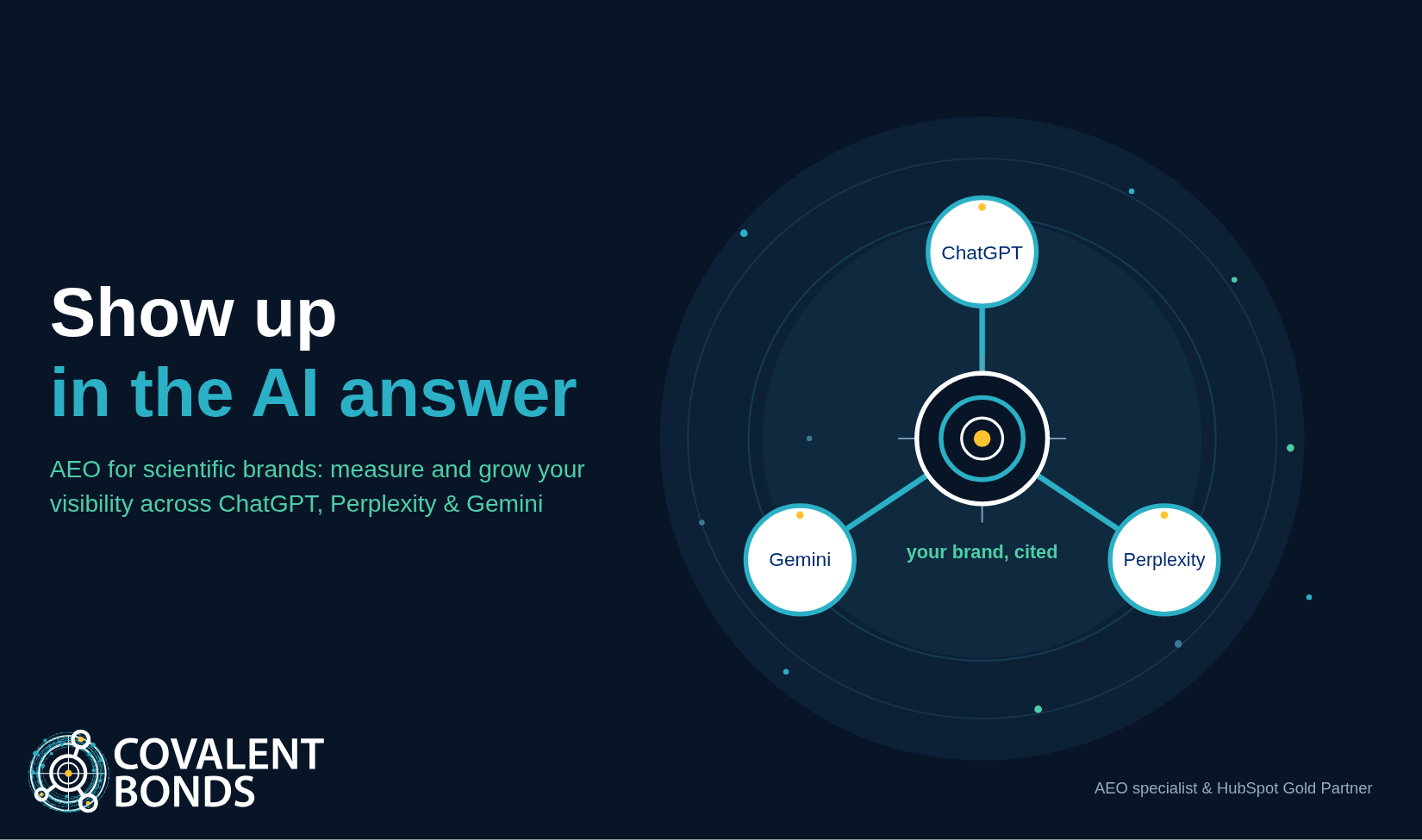
- The Baseline: Integrating on-page JSON-LD code and structured technical schema is one of the most critical foundational levers a company can pull to achieve direct visibility in conversational AI search engines (like ChatGPT, Google Gemini, and Perplexity).
- The Validated Alternative: Lacking backend website control does not preclude execution of Answer Engine Optimization (AEO). AI retrieval layers evaluate brand credibility using external consensus, independent citations, and entity co-occurrence across the broader internet. As demonstrated by HORIBA’s North American Operations, marketers can secure prime AI search real estate by leveraging Technical Public Relations (PR)—placing data-dense evidence into credible, already-cited third-party trade magazines, and then anchoring those external wins locally on their permitted web pages.
For regional commercial teams and technical directors selling complex laboratory instrumentation and services, achieving visibility in modern search architectures presents a distinct operational challenge.Laboratory buyers conduct up to 70–90% of their procurement cycle in a "silent research" phase, frequently interrogating conversational AI tools to evaluate technical infrastructure. To capture this market share, a company’s instrumentation must be retrieved and cited directly within these conversational AI answer boxes.
In standard search engine optimization, one of the most critical levers to secure this real estate is deploying structured JSON-LD data and optimizing site-wide technical schema. However, within centralized global organizations, regional teams often face a bottleneck: the website development is centralized and poses challenges for new development. In these environments, deploying custom code requires navigating multi-month IT ticket queues, compliance reviews, and localized security hold-ups.
It is a common misconception that if you do not have control over your website’s backend code, you cannot compete in AEO or Generative Engine Optimization (GEO).
HORIBA’s North American Operations disproved this limitation. Facing strict global corporate website constraints that prevented localized backend schema updates, HORIBA’s regional team utilized targeted Technical PR to establish visibility. By focusing heavily on placing high-value articles into external trade publications that conversational engines already trust, scan, and cite, they successfully captured the definitive real estate in conversational AI search graphs.
Jamie Bibb at HORIBA Instruments Incorporated outlines the operational reality of this framework:
"By focusing heavily on building external digital authority through technical thought leadership, and carefully closing the loop on our regional pages, we proved that JSON code is not the only lever to pull to dominate the AI search landscape."
While on-page technical schema remains a vital technical signal, HORIBA’s success highlights a powerful parallel path. AI models rely heavily on external credibility networks and third-party validation. By treating public relations not as a soft vanity metric for "brand awareness," but as a highly tactical, data-driven engine for AI discovery, you can establish an un-shakable authority footprint that operates alongside global backend code structures.
The Mechanism: How AI Engines Evaluate Scientific Validity
Highly trained scientists and research leaders possess an exceptionally high barrier to entry when evaluating commercial claims. AI engines are architected to mimic this precise skepticism. When an AI engine processes a technical user query—such as evaluating analytical methodologies for bioprocess monitoring—it does not rely solely on self-reported marketing copy hosted on a vendor's homepage.
Instead, the retrieval algorithm parses the broader web graph to evaluate three core criteria:
- Independent Citation: Is the instrumentation or methodology being actively analyzed within reputable, third-party industry journals and trade magazines?
- Expert Authority: Are the individual authors associated with the commercial entity recognized contributors within that specific scientific niche?
- External Verification: Do high-authority, external domains structurally validate the scientific assertions made by the commercial brand?
When a centralized IT department restricts backend code access, you are temporarily cut off from an important on-page optimization tool. However, as HORIBA demonstrated, you can still drive exceptional AEO performance by feeding the AI engine the peer-validated, external evidence it natively prioritizes via targeted media placements.
The Execution Blueprint: The Three-Step Technical PR Framework
Step 1: Deploy Technical PR Outside Your Domain
To satisfy both critical research leaders and AI parsing algorithms, avoid standard marketing-heavy content or generic corporate announcements. Your internal Subject Matter Experts (SMEs) must author deep technical articles that mirror the structural DNA of a peer-reviewed paper: Introduction (the bioprocess bottleneck), Methods (the Raman instrumentation parameters), Results (the real-time analytics data), and Discussion (the impact on critical quality attributes).
Pitch and place this high-density content into credible, high-domain-authority trade magazines that search engines and LLM crawlers already scan, index, and cite as source material. The article immediately inherits the publisher's established domain credibility.
Step 2: Build the Visible Bridge on Your Permitted Website Infrastructure
Publishing an article in external media is an excellent validation step, but an isolated article on a publisher’s site doesn't automatically confer trust to your local brand unless you explicitly connect the data. Many marketers fail here by simply uploading a static logo or an empty press link that crawlers cannot semantically decode.
While global IT constraints may block you from altering backend code, your localized CMS permissions almost certainly allow you to update standard editorial pages. Look at HORIBA’s live execution framework: they deployed a dedicated In the Media resource directory. Instead of empty vanity clippings, this page features clean, text-based summaries that contextualize the specific application parameters, methodologies, and technical problems solved within each external PR placement.
Step 3: Anchor the Semantic Connection
From those clean text summaries on your local page, embed direct outbound hyperlinks pointing straight to the final article hosted on the trade magazine's website. This outbound architecture functions as a digital validation loop. When an LLM crawler traces the web graph, it maps the explicit relationship between your permitted regional web space and the trusted external publication. The algorithm computes the connection: "This external, high-authority trade data structurally validates the technical capabilities of this commercial entity."
The Empirical Proof: Capturing the AI Answer Box
This methodology yields concrete, trackable data that directly answers the attribution challenges historically associated with public relations.
In a recent live conversational search audit tracking specialized biopharma workflows, a direct user query asked: "Can Raman spectroscopy be used to monitor critical quality attributes in biopharmaceuticals?"
The engine immediately generated a comprehensive AI Overview section detailing real-time, in-line analysis parameters for cell culture media. When the source citations backing up that specific AI response were audited, the data was definitive: four of the core sources feeding that AI answer box were the direct result of HORIBA’s technical PR loop. HORIBA achieved this search dominance while their website's underlying code remained completely untouched by their local team.
Operationalizing the Strategy
For commercial leaders managing localized budgets and strict pipeline targets, waiting indefinitely for global corporate IT alignment introduces a severe opportunity cost. Lacking immediate access to your primary on-page lever should never stall your marketing momentum.
To execute this model independently of backend constraints:
- Pivot your PR budget toward highly technical, data-driven editorial features authored by internal technical experts rather than generic, brand-heavy press releases.
- Reconfigure your permitted website infrastructure to act as a structured resource directory (mirroring HORIBA’s text-summary framework) rather than a static gallery of un-crawlable logos.
- Close the loop meticulously by ensuring every text summary contains an explicit outbound link that bridges your localized product lines directly to the external publication.
By treating public relations as a deliberate, technical component of AI discovery, scientific marketers can secure prime retrieval slots in conversational search, maximize their regional digital footprint, and consistently de-risk the procurement process for skeptical buyers.
Frequently Asked Questions
If I cannot edit my website's JSON code, can an AI engine still associate external PR articles with my brand?
Yes. While on-page JSON code is a highly direct way to signal relationships to search engines, AI models do not rely on it exclusively. They use advanced text analysis to look for relationship patterns across the internet. When your brand name and your technical experts are repeatedly mentioned alongside specific methodologies (like Raman spectroscopy) on trusted third-party websites, the AI automatically maps those relationships together. Linking out to those articles from your permitted companion pages confirms that connection.
Why isn't a static press release or a publisher's logo sufficient for AI Answer Engines?
AI crawlers read text strings and link structures; they cannot read or understand the contextual meaning inside an image file or a corporate logo. Uploading a flat graphic of a media win creates a semantic dead-end for an AI. To ensure you get noticed, the page must feature concise, crawlable summary text containing your relevant technical terms alongside an active link to the source article.
How long does an external PR thought leadership strategy take to show up in AI search boxes?
While on-page technical changes can sometimes be parsed quickly, an external PR strategy relies on search engines crawling third-party media outlets and recalculating the credibility of your overall web presence. Data shows results typically manifest within 4 to 12 weeks of publication, depending on how frequently the external scientific journal or trade magazine is crawled by search engines.
Explore our AI-forward MarComs service, or browse all of our services.
You may also be interested in reading
Lazarus Risen: The Definitive Trade Media Strategy for Scientific Marketing SEO and AEO Authority
How LLMs Harvest Reddit Data for Scientific AEO (And How to Win B2B Mindshare)
Precision PR: How Data Can Cut Your Media Spend by 50% While Securing Your Future in AI Search