
Your buyers are asking ChatGPT, Perplexity, and Gemini which vendors to shortlist before they ever reach your website. For marketers at scientific brands, that shift breaks traditional reporting: rankings and traffic can't tell you whether an answer engine named your instrument, reagent, or platform, why it did, or what to fix. Answer Engine Optimization (AEO) closes that gap. This guide explains why old SEO metrics fall short, which KPIs matter for AI search, and how to use HubSpot's AEO tool to track and improve your presence in AI answers.
Key takeaways
- Rankings and traffic are no longer enough for AI search reporting, because AI answers often satisfy a query before any click — your brand can gain visibility while your session count stays at zero.
- The KPIs that matter for AI visibility track presence (how often you're mentioned or cited), accuracy (whether you're described correctly), and competitive position (your citation share against rivals).
- Answer engines pull from more than your website — reviews, Reddit, YouTube, news, and comparison pages all feed the answer — so your visibility depends on the whole web, not just your homepage.
- HubSpot's AEO tool tracks prompts relevant to your business across ChatGPT, Perplexity, and Gemini, then reports brand visibility, competitor share of voice, citation patterns, and prioritized recommendations.
- AI visibility creates value even without a click, and it correlates with branded search and direct traffic over time — so report trends across multiple cycles, not one-day readings.
Why aren't traditional SEO metrics enough for AI search reporting?
Rankings and organic traffic are no longer enough because they measure what happens after a click, and AI answers often satisfy a query before any click occurs. A scientist can read your product description or learn what your platform does inside an AI response without a single session showing up in your analytics. Your traffic can stay flat while your brand visibility grows significantly.
That means traffic can no longer be the primary KPI for AI search performance. The metrics you need instead measure how often you appear in AI answers, how accurately you're represented, and whether that presence is influencing decisions that drive site visits, sign-ups, and purchases. This is a reporting problem before it's a content problem: you cannot improve what you cannot see, and standard web analytics render AI visibility invisible.
What is AEO, and how is it different from SEO?
AEO is the practice of measuring and improving how your brand appears in AI-generated answers. It complements SEO by focusing on whether an answer engine names and cites your brand, not just where your pages rank in a list of links. SEO optimizes for a ranked list; AEO optimizes for the synthesized answer an LLM writes when a buyer asks a question.
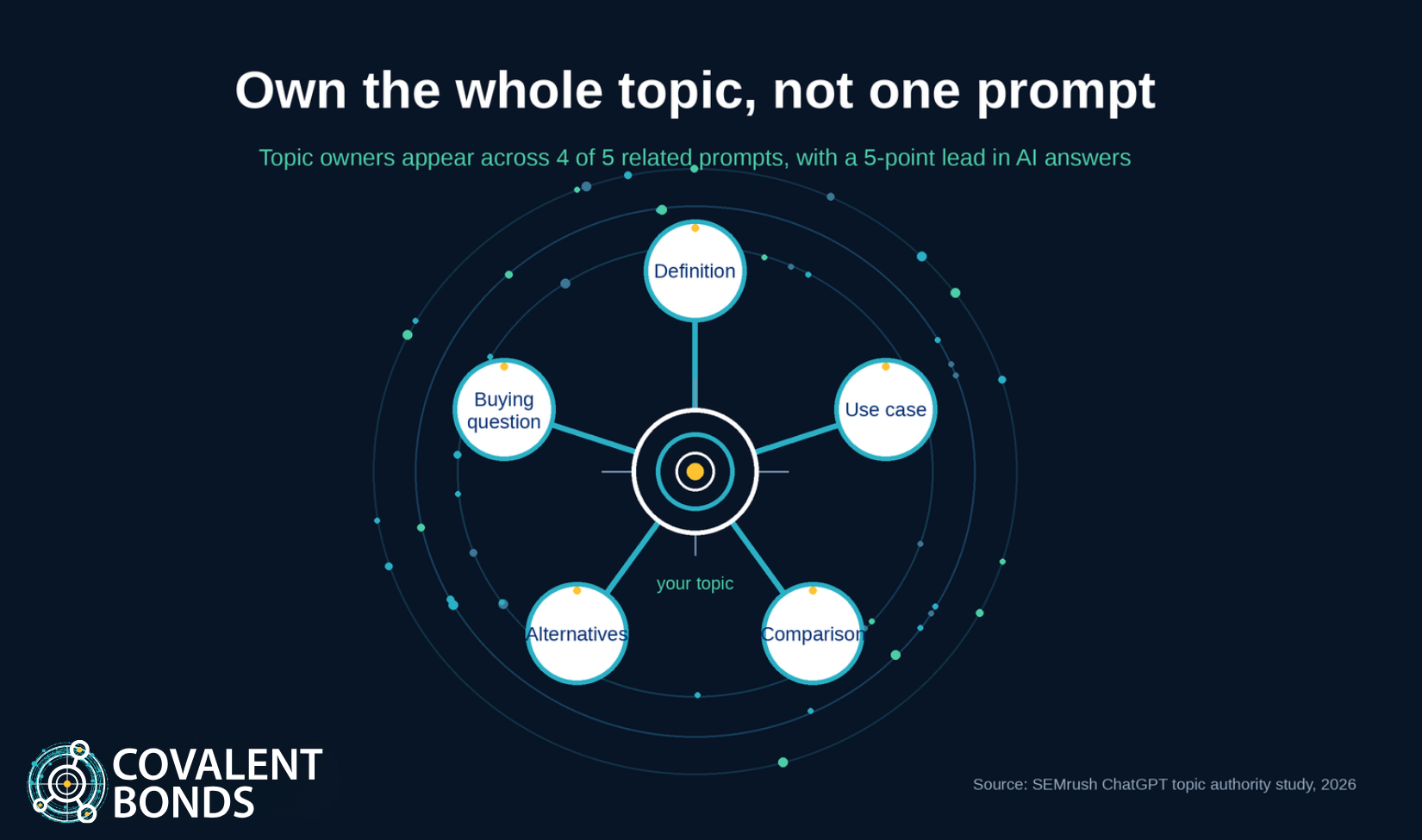
The difference matters because of how answer engines work. When a buyer types a prompt, the LLM retrieves and stitches together content chunks from across the web, then names specific vendors and cites specific sources. If your content isn't machine-readable, well-structured, and corroborated by sources the model trusts, the engine has nothing clean to lift — and it names a competitor instead.
Why does AI visibility matter specifically for scientific brands?
AI visibility matters for scientific marketers because technical buyers increasingly use AI tools to research categories, compare vendors, and build shortlists before contacting sales. Scientific purchases involve long evaluation cycles and detailed technical criteria — exactly the research a buyer now front-loads by asking an engine "what are the best options for X" or "how does vendor A compare to vendor B."
There's a second reason tied to how LLMs build trust. Answer engines weight authoritative, corroborated sources when deciding which brand to name. Scientific credibility signals — technical documentation, peer-cited content, trade-press coverage, and consistent product data across the web — are the evidence an LLM uses to decide your brand is a real, trustworthy answer. If those signals are thin or inconsistent, the model has less reason to surface you, however strong your products actually are.
Which KPIs matter most for AI visibility reporting?
The KPIs that matter track three things: presence, accuracy, and competitive position. Reporting any one alone gives a misleading picture, so pair them.
|
KPI dimension |
What it answers |
Why it matters |
|---|---|---|
|
Presence (citation/mention frequency) |
Are we visible in AI answers? |
Mention frequency across a consistent prompt set is the core signal of AI visibility. |
|
Accuracy (how you're described) |
Does AI describe us the way we want? |
A citation that misrepresents your specs or positioning can do more harm than no citation at all. |
|
Competitive position (citation share) |
Are we winning or losing to rivals? |
Frequency alone doesn't show standing; share of voice shows where an engine names a competitor instead of you. |
When you report to stakeholders, translate platform data into outcome language. Instead of "we appear in 42% of AI responses for prompt set A," say "AI tools now recommend us in nearly half of all responses when someone compares options in our category." Executives need to know three things: are we visible, are we described accurately, and are we gaining or losing ground against competitors.
What does HubSpot's AEO tool do?
HubSpot's AEO tool tracks prompts relevant to your business across answer engines like ChatGPT, Perplexity, and Gemini, then reports how visible your brand is, how competitors compare, which sources are cited, and what to improve. It turns "are we showing up in AI answers?" into measured data plus a prioritized action list. HubSpot makes it available in the AI visibility area of the platform.
It does four things that map directly to how LLMs surface brands:
- Measures AI discovery. It tracks how often your brand is mentioned across your tracked prompts and supported engines — your core presence signal.
- Benchmarks competitors. It shows competitor visibility and share of voice, so you can see where an engine names a rival instead of you.
- Reveals which sources influence answers. It tracks citations, top domains, and your owned-domain citation rate, showing whether the engine trusts your own content, third-party sources, or competitor content for a topic.
- Prioritizes next actions. Recommendations come from patterns HubSpot finds in your actual AI answers and citations, so they target observed gaps, not generic advice.
Because answer engines pull from third-party sources — reviews, Reddit, YouTube, news, and comparison content — not just your website, the tool helps you see the broader picture of how your brand is represented across the web LLMs read from. In one line: HubSpot's AEO tool shows how your brand appears in AI answers and tells you which content and visibility gaps to fix so you get cited more often.
How do you set up and use HubSpot's AEO tool?
Set up starts by confirming your brand details, competitors, products, ICPs, and the prompts you want to track; HubSpot then runs those prompts daily and aggregates visibility over time. The workflow below follows HubSpot's recommended approach.
|
Step |
What to do |
Why it affects AI visibility |
|---|---|---|
|
1. Build the foundation |
Add your brand name, domain, brand variations, competitors, products/services, and ICPs. |
Prompt generation uses this context, so accurate inputs produce prompts your buyers actually ask. |
|
2. Set your prompts |
Start with suggested prompts, add commercial questions buyers ask, and organize around the buyer journey: awareness, consideration, evaluation, decision. Commit to a fixed prompt set per reporting period. |
Expanding a prompt set mid-cycle inflates mentions without showing real improvement. |
|
3. Read the dashboard |
Review brand visibility, visibility over time, share of voice, competitor visibility, and citation trends. |
These show your standing in AI answers and how it moves as you act. |
|
4. Go deeper into prompts |
See which prompts you appear in, which competitors appear instead, which sources are cited, and how visibility shifts by engine and date. |
Prompt-level gains appear before aggregate share moves — your earliest signal of progress. |
|
5. Review citations |
Ask whether the engine cites your site, third parties, or competitors, what content types it prefers, and which formats rivals earn citations in that you don't produce. |
Citations reveal which sources the LLM trusts for your topic — your fix list. |
|
6. Act on recommendations |
Use the recommendations tab to prioritize content or visibility work. |
HubSpot generates these from recurring citation and competitor patterns across your prompts. |
|
7. Re-measure |
Compare across multiple cycles, not single days. |
AI answers shift over time, so improvements show as trends. |
How do you connect AI visibility to traffic, leads, and revenue?
Because AI answers don't pass reliable click-level data, attribution requires building a correlation case rather than a single clean number. Track AI referral sessions in your analytics, branded search volume, and conversion rates over time. When AI visibility grows, branded search tends to follow; when branded search grows, conversions tend to follow. Documenting that chain across several reporting cycles is the evidence that holds up in planning conversations.
AI visibility also creates value even without a click. When an engine cites your brand in an answer about category options, the buyer is exposed to your name, positioning, and sometimes your differentiators before they reach your site — building share of mind that later shows up as branded-search spikes and higher direct-visit rates. For scientific brands with long sales cycles, being present at the research stage compounds.
How should scientific marketers get the most out of it?
Lead with the prompts your buyers actually ask, not brand vanity terms, and include unbranded category, comparison, and "best vendor" prompts — that's where new buyers discover you before they know your name. Use AEO alongside SEO, which is how HubSpot positions it. Watch competitor citation wins to spot missing formats, topics, and proof points, but don't copy blindly.
For content, we recommend making pages easier for engines to parse and cite: direct, concise language; clear headings and consistent structure; lists, steps, and tables where appropriate; schema markup; strong image alt text; clear rules and constraints; and worked examples for complex topics. For scientific brands, that means turning dense technical material into cleanly chunked, self-contained answers an LLM can lift verbatim. Keep pages fresh and add unique data LLMs can't find elsewhere — both raise your chance of being retrieved.
For visibility, build authority beyond your own site through reviews, earned media, forums, and comparison pages, since consistency, authority, and content density across the wider web all shape whether you get named. One caution: AEO is not "publish one page and win." It works when you combine structured content, strong brand context, multi-channel visibility, and ongoing measurement.
Work with an AEO specialist and HubSpot Gold Partner
Getting named in AI answers takes both AEO expertise and hands-on command of the tools that measure it. Covalent Bonds is both an AEO specialist and a HubSpot Gold Partner, so we help scientific brands set up HubSpot's AEO tool correctly, build the prompt sets your technical buyers actually ask, and turn citation and competitor data into content that gets you cited more often. Explore our services to see how we can grow your visibility in AI answers.
Frequently asked questions
Is AEO a replacement for SEO? No. AEO complements SEO. SEO optimizes your rank in traditional search results; AEO focuses on whether and how AI engines name and cite your brand. HubSpot explicitly positions AEO to be used with SEO, not instead of it.
Why can't I just use traffic to measure AI search performance? Because AI answers frequently satisfy a query without sending a click. Your traffic can stay flat while your brand visibility grows, so mention frequency, citation share, and branded-search correlation are better signals than sessions alone.
Which answer engines does HubSpot's AEO tool track? It tracks prompts across answer engines including ChatGPT, Perplexity, and Gemini, running your tracked prompts daily and aggregating visibility over time.
Why does my brand show up for some prompts but not others? Answer engines synthesize each answer from sources they trust for that topic. If your content is missing, hard to parse, or less corroborated than a competitor's for a prompt, the engine names them instead. The prompt and citation views show exactly where.
How do I explain AI visibility to leadership? Structure it around four questions: where do we appear, how accurately are we described, is our position improving versus competitors, and which business metrics are moving as a result. Report outcomes, not retrieval mechanics.
How quickly will visibility improve after I make changes? Not immediately, and it depends on how competitive your category is. Prompt-level appearances usually shift first; aggregate citation share and accuracy take longer. HubSpot recommends comparing across multiple cycles and reading trends, not single-day swings.
.png)