
Google and AI answer engines reward the same two things: content that directly answers what a person asked, and citations from trusted sources that already cover that subject. We covered the evidence for that in our breakdown of the 2026 ranking factors survey — Do Backlinks Still Matter for AI Search?
This post is about the part that survey does not solve. Neither relevance nor authoritative citation is a task. Both are outcomes that only appear when several disciplines are working on the same subject at the same time. A marketing department split into separate content, digital, PR and demand-generation functions can complete every task on its list and still produce nothing an answer engine will quote.
That is an org chart problem, not a tactics problem. Here is what breaks, and what a small scientific marketing team can do about it without hiring anyone.
Key takeaways
- No single department can produce an AEO outcome. Relevance needs prompt data from digital plus expertise from a scientist. Citation needs original data from content plus placement from PR. Each half alone produces a deliverable nobody can use.
- 84% of AI citations come from earned media, journalism alone at 27% (Muck Rack, May 2026). Content that never leaves your own domain is competing for a small share of what engines quote.
- 69% of B2B buyers report inconsistencies between a supplier's website and what its sellers tell them, and 73% actively avoid suppliers who send irrelevant outreach (Gartner). Both are silo symptoms, and both weaken the entity signals AI engines use to identify what a company is authoritative on.
- AI compressed execution, not coordination. Drafting, formatting and analysis now take minutes. The wait between departments still takes weeks, so the handoff is now the entire timeline.
- A cross-functional pod caps out at 8 to 12 people and works in short cycles rather than campaigns (McKinsey). A 1–3 person scientific marketing team can run one by borrowing the domain expert rather than hiring one.
Why can't a siloed marketing team produce AEO results?
Because each AEO outcome requires an input that lives in another department. The work divides cleanly along org chart lines; the outcomes do not.
|
AEO outcome |
What the engine sees |
Inputs it needs, and who holds them |
|
Relevance |
A passage that answers the exact question asked, quotable without losing its subject |
The real prompts buyers type (digital / RevOps) + an accurate technical answer (domain scientist) + structure a model can lift (content) |
|
Authoritative citation and backlinks |
A trusted, topically relevant site linking to and naming your company on that subject. One placement counts twice: a quality backlink for Google (SEO) and a citable source for answer engines (AEO) |
Original first-party data (domain scientist) + a publishable angle (content) + the placement and the link (PR) |
|
Topical authority |
Consistent presence across every related question in one subject |
A chosen topic, coverage gaps identified, and every discipline publishing into the same cluster |
Read that table as a list of failure modes. A content team without prompt data writes accurate answers to questions nobody asked. A PR team without original data places a press release instead of a finding. A digital team without a scientist optimises pages that say nothing only you could say. Every department hits its own targets. The company still does not get quoted.
This is why "we do content, and we also do PR" is not the same as doing AEO. Sequence and shared subject are the whole mechanism.
How does a silo show up in the way engines and buyers see you?
As inconsistency. When separate teams describe the same company in different words, two things happen at once, and both are measurable.
Buyers notice first. Gartner found 69% of B2B buyers report inconsistencies between the information on a supplier's website and what its sellers tell them, and 73% actively avoid suppliers who send irrelevant outreach. In a technical purchase, where the buyer is already checking your claims against their own knowledge, an inconsistency is not a branding problem. It is a disqualification.
Machines notice for a different reason. An AI answer engine builds an entity — a stable idea of what your company is and what it is authoritative on — out of how you are described everywhere it reads you: your site, your trade coverage, your product pages, third-party mentions. Four teams using four different names for the same technology, four descriptions of the same capability and four content calendars produce a blurred entity. The model has nothing consistent to attach to a subject, so it reaches for a competitor that reads the same way everywhere.
Consistent naming and messaging is usually filed under brand. In AEO it is closer to plumbing: it is what lets a model connect your company to a topic at all.
Why has AI made departmental handoffs the real bottleneck?
Because execution time collapsed and coordination time did not. Drafting, reformatting, summarising and first-pass analysis now take minutes. The three-week wait for another department to pick up the work is unchanged.
That changes what the bottleneck is. When a task took a week and the handoff took three weeks, the handoff was a nuisance. When the task takes an hour and the handoff still takes three weeks, the handoff is the whole timeline. Speeding up execution further does nothing.
It also changes what a cycle should look like. AI visibility is unstable — a brand's presence in a topic can shift month to month — so coverage has to be checked and maintained continuously rather than shipped as a campaign and reviewed next quarter. A structure built around quarterly handoffs cannot run a monthly loop, whatever tools it buys.
Related reading: From SEO to AEO: Navigating the Paradigm Shift in Scientific Marketing · Why Does AI Describe Your Science Company as the Wrong Kind of Business?
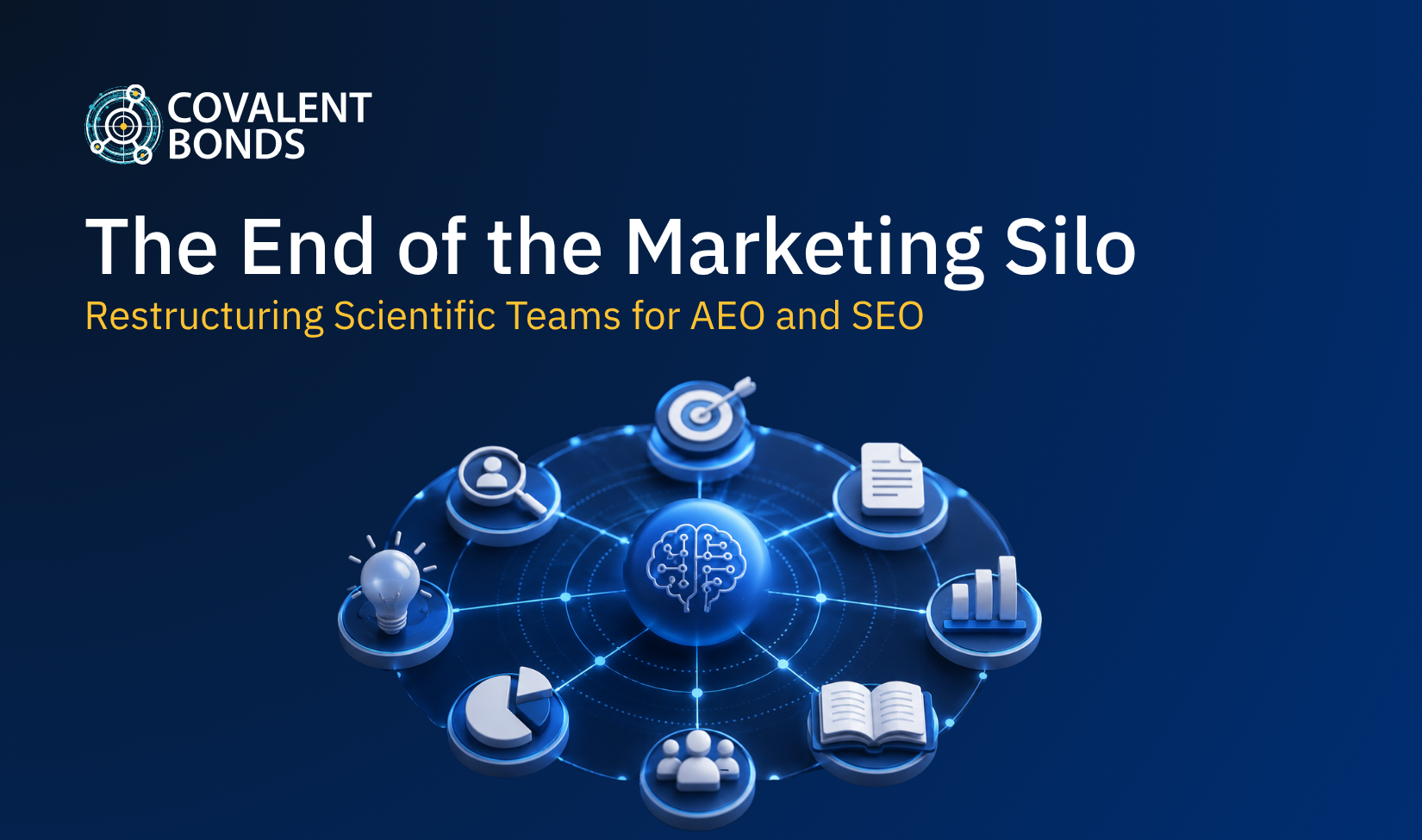
What goes into a cross-functional AEO pod?
Three functions, working on one topic, in short repeating cycles. In a scientific company they map to people you mostly already have:
|
Function |
Who this usually is |
What it contributes to the engine |
|
Domain expert |
An existing application scientist, technical director or senior PhD — borrowed, not hired into marketing |
Accurate technical answers and original first-party data: the material nobody else can publish and models cannot find elsewhere |
|
RevOps / analytics |
Whoever owns your CRM and reporting, or a fractional analyst |
Prompt and citation monitoring, so coverage is directed at real gaps rather than guessed |
|
Content and brand lead |
Usually the marketing manager |
Consistent naming and structured data, publishing, and turning the scientist's data into something a trade editor will run |
Two structural rules travel with this. McKinsey's work on agile marketing puts the maximum effective squad size at 8 to 12 people — past that, coordination cost returns. And the squad decides its own work in short sprints, which means the unit of planning is a cycle, not a campaign.
For most scientific companies in the 50 to 500 employee range, that ceiling is irrelevant. The real question is the floor, and the floor is three functions — which is not the same as three full-time marketing hires.
Why does a stack of specialist agencies make this worse?
Because it puts a contract boundary at every handoff, and the brief-and-handoff model is the thing that has to go.
McKinsey's analysis of how agile marketing breaks the agency model makes the mechanism explicit: traditional agencies take a detailed brief, produce a fixed deliverable, and pass it on. In a cross-functional squad, the deliverables change every cycle as the squad decides what the data says to do next. That is incompatible with per-deliverable pricing and with a partner who is not in the room. Their conclusion — that the agency contributor needs to be dedicated and present rather than briefed — is the same conclusion in agency terms.
|
Four specialist agencies |
One integrated function |
|
|
Topic selection |
Each picks its own |
One topic, chosen from prompt and gap data |
|
Original data |
Rarely reaches the PR agency at all |
Flows from the internal scientist into every output |
|
Backlinks and citations earned |
Volume-led, topically scattered |
Trusted domain, topically relevant, tied to the chosen topic |
|
Planning unit |
Campaign with a fixed scope |
Cycle, re-planned on what the data shows |
|
Who coordinates |
The client — usually one person |
The integrated team |
The last row is the one that decides it. Four agencies each deliver their piece and leave the joining-up to whoever holds the contracts. On a one-person marketing team, that person is the bottleneck, and the coordination simply does not happen.
How does a one to three-person team actually run this?
By shrinking the scope, not the structure. Three constraints make a pod work at that size:
Borrow the expert, do not hire one. The domain scientist in the pod is an existing colleague contributing a few hours per cycle: a data set, a technical review, twenty minutes on what customers actually ask. Marketing's job is to make that ask short, specific and scheduled. Vague requests for "input" are what kill internal expert involvement.
One topic, covered completely. A thin team cannot cover five subjects. It can cover one narrow subject fully — which is also the structurally easier win, since niche topics have far fewer brands competing to own them. See Winning in AI Search Means Owning a Whole Topic, Not a Single Prompt.
Measurement inside the system you already use. Anything that needs manual carrying between tools every month will stop happening by month three. Prompt tracking, citation monitoring and reporting have to sit where the team already works.
What that produces is a repeating cycle rather than a restructure:
- Find the gap. Prompt monitoring shows which questions in your topic you are absent from, and who is named instead.
- Get the data. The internal scientist supplies first-party material — application results, method comparisons, failure-rate analysis — that exists nowhere else.
- Publish the answer. Content writes it directly against the missing questions, in self-contained passages a model can quote.
- Place it. PR takes the same finding to a trade title the engines already trust, which produces the topically relevant citation.
- Re-measure. Share of voice on the target questions, citation share and accuracy, plus branded search and direct traffic.
Five steps, one topic, three people who mostly already work there. No step can be completed by the function that owns it alone, which is precisely why the silo has to go.
Frequently asked questions
Why do marketing silos hurt AI search visibility? Because AEO outcomes need inputs from several functions at once. Relevance needs prompt data from digital plus technical accuracy from a scientist. Authoritative citation needs original data from content plus placement from PR. A department working alone can complete its own task and still produce nothing an answer engine will quote.
What is a cross-functional marketing pod? A small team that owns one topic end to end rather than passing work between departments. For a scientific company the minimum is three functions: a domain expert for accuracy and original data, an analytics owner for prompt and citation monitoring, and a content lead for publishing and consistency. McKinsey puts the maximum effective size at 8 to 12 people.
Can a one-person marketing team do AEO properly? Yes, if the scope is one narrow topic, the internal scientist is committed to a few scheduled hours per cycle, and the measurement runs inside the tools the team already uses. What a thin team cannot absorb is five topics at once or a process that requires manually moving data between systems every month.
How do you get internal scientists to contribute to marketing content? Make the ask short, specific and scheduled rather than open-ended. A named data set, a 30-minute review, or a list of the questions customers ask them most. Requests for general "input" on a content calendar reliably go unanswered.
Should we hire separate agencies for SEO, content and PR? For AEO work, no. The topic, the original data and the placement have to be decided together, and separate agencies put a contract boundary at every handoff. The coordination then falls to the client — usually the one person with the least time for it.
What does inconsistent messaging do to AI search visibility? It blurs the entity. An answer engine builds its idea of what your company is authoritative on from how you are described everywhere it reads you. Four teams using four different names for the same technology give the model nothing consistent to attach to a topic, so it reaches for a competitor that reads the same way everywhere.
How do you measure whether a cross-functional AEO team is working? On share of voice across your topic's questions, citation share and citation accuracy, and topic ownership — not on leads attributed to an AI engine. Technical buyers research in AI and verify with peers, so the early signals show up in branded search and direct traffic well before they show up in a contract.
Start with one topic
You do not need a reorganisation to start. You need to know which questions your buyers are asking in your topic, where your company is named, and where a competitor is named instead. That baseline takes days, and it tells you which topic is worth pooling your people around — whether you are an analytical instrument maker, a CRO, a CDMO or a reagent and antibody supplier.
Sources: When agile marketing breaks the agency model and Agile marketing: a step-by-step guide, McKinsey. Gartner 2025 B2B Sales Survey. What is AI Reading, May 2026, Muck Rack.