
Why is AEO a PR-first strategy for technical B2B companies?
Alternative Definitive Answer Block (66 words)
Answer Engine Optimization (AEO) starts with PR because AI platforms build company descriptions from more than a brand's website. Trade publications, industry media, analyst coverage, and other third-party sources all influence how a company is represented in AI-generated answers. Earned media shapes that external narrative, while Schema.org markup helps platforms connect that coverage to the correct company and understand its current positioning. After a repositioning, using both together can help outdated descriptions give way to more current ones.
Key Takeaways Box
- Funnel Collapse: Buyers are increasingly doing their research inside AI tools before they ever visit your website.
- External Consensus Trumps Owned Web: More than 84% of AI citations come from earned media, according to Muck Rack’s Generative Pulse research
- The Multi-LLM Bias: Relying on a single LLM for market research creates dangerous strategic blind spots due to differing source priorities.
- The Action Item: Modern AEO requires securing earned media in respected trade publications so AI search tools can surface current, credible information about your brand when prospective customers are evaluating solutions.
- Pair with Schema Match: Pair your media efforts with structured entity markup (Schema.org Organization/Product) on your site, to help AI tools confirm your current positioning.
The Discovery: Why Claude Got Our Prospect’s Business Model Wrong—and What It Taught Us
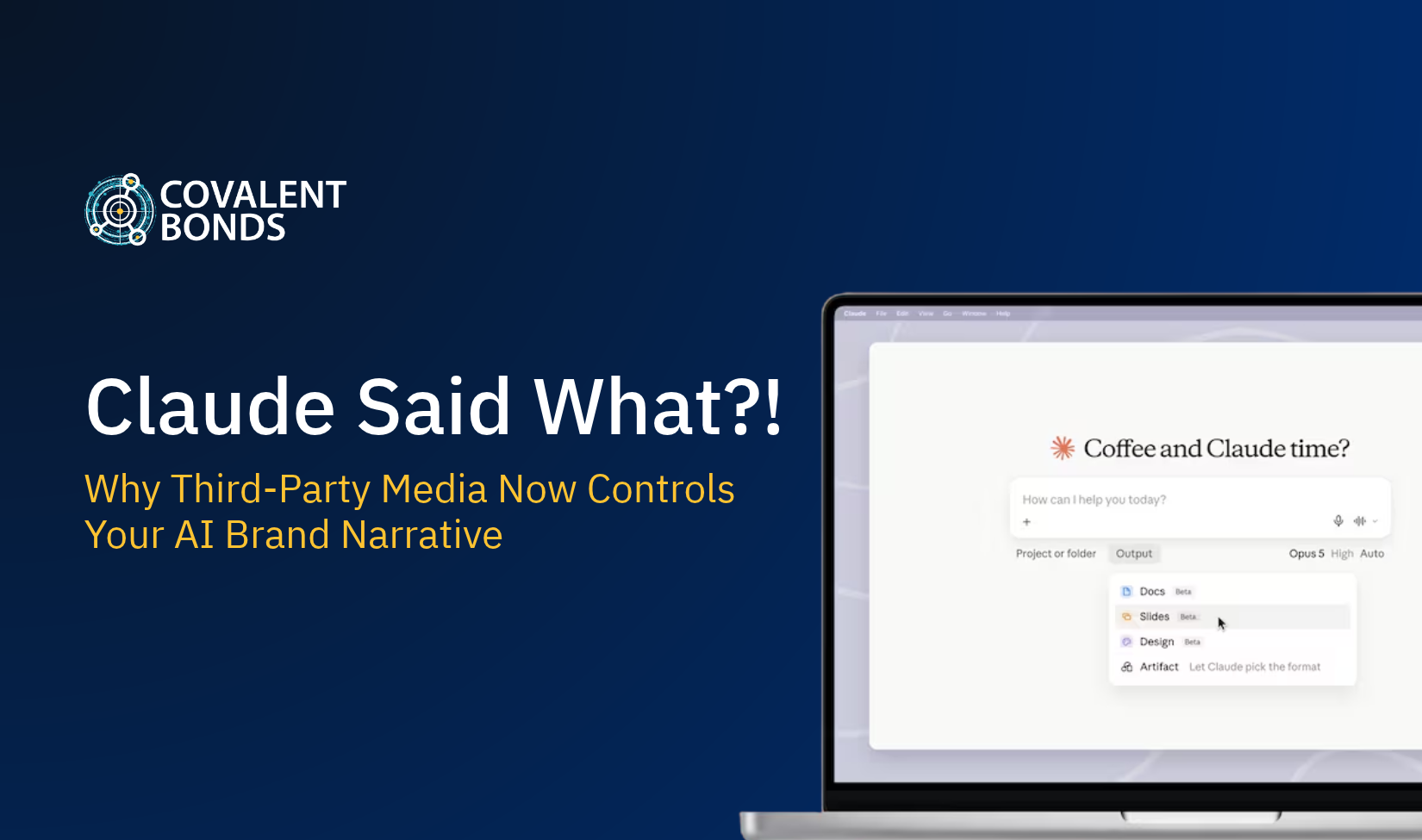
I was recently prepping for a meeting with a potential new client and got quite a wakeup call when I asked Claude and Gemini to help prepare me with a high-level overview of the company. To my surprise, I got two very different answers. Gemini correctly used homepage copy to identify the business as an innovator in the medical device space. Meanwhile, Claude insisted they were a drug discovery company based on outdated 2024 external sources. Even after I quoted the homepage, Claude continued to rely on older articles and interviews. Since the company had reorganized recently and changed its business model, Claude was picking up on information that was very out of date. This means that if a prospective customer posed the same question while researching vendors, they would come away without ever really understanding the company's capabilities and value. This is a clear example of what can happen when you update your positioning but don’t share the changes with the trade press and other external audiences.
A similar scenario occurred when a B2B client recently updated their owned site to reflect a strategic shift from an "ingredient/component supplier" to a "full-service provider." This sounds straightforward enough, except for one critical issue: popular LLMs continued to index and recommend the company as an ingredient supplier because the vast majority of historical external references across the web still labeled them that way. Again, the issue was that the client’s new positioning wasn’t being picked up by the trade press and other external sources. As a result, the company risked being excluded in the search results for full-service partners and instead was being classified by their former business model. Interestingly enough, while the company website was updated, the external sources that helped shape its reputation didn’t reflect these changes. Much of the online information the AI tools were drawing from was very out of date.
The current reality is that the sales journey is rapidly shifting. While the buying process once took place through multiple visits to your website to learn about your offerings, today it increasingly occurs inside AI platforms before customers ever visit your site. Forrester’s 2025 Buyers’ Journey Survey supports this shift: the findings reveal that 94% of business buyers now use AI in some way during the buying process.
As the rules change, you need to make sure your business processes are adapting, as well.
How is AI Changing the Scientific and Technical Sales Journey?
B2B buyers and procurement agents are now using LLMs as research and decision-support tools throughout the entire purchase cycle. These tools are helping them research products, find the best fit for their specs, compare vendors, prepare RFPs, and prepare business cases, all while reducing the investment in time and money required by manual processes. This shift is having a significant impact on how business is done. Many of our clients are seeing a decline in website traffic even as there is an increase in qualified leads who are engaging with sales teams and are much further along in the buyer cycle. This means that by the time they hit your CRM, much of the decision is already made.
The Positioning Pivot Trap: Why Isn’t My Company Website Copy Enough?
In order to take advantage of these shifts, you need to stay on top of your online reputation. Muck Rack’s ongoing Generative Pulse research recently revealed that earned media drives 84% of AI citations. One reason is because AI tools build an image of a company based on how it’s described across the industry through articles, interviews, white papers, and more. When the same descriptions appear in multiple places, it helps shape your company’s narrative, even if it isn’t accurate, as was the case with our client who pivoted from a supplier to service provider yet the LLM didn’t catch the change. Updating your homepage copy alone rarely fixes this. Just keep in mind that the trade coverage must also match the structured data that tells machines what kind of company you are.
Why Do Different LLMs Provide Different Results?
Different AI tools can provide very different results for the same search because each LLM retrieves and classifies information differently when it comes to content provided on a company’s own website or information from an independent third-party source. A 2025 study from the University of Toronto reinforces this idea. The researchers found that AI search engines are overwhelmingly biased toward earned media over brand-owned copy. They also discovered that platforms prioritize sources differently, with ChatGPT and Claude leaning more heavily on third-party sources, while Gemini gave relatively more weight to company websites, which mirrors what we saw first-hand.
This makes it essential for technical teams to cross-validate research across multiple platforms, including ChatGPT, Gemini, and Claude. In our testing, some models prioritized corporate copy, while others valued third-party content more heavily. As a result, the same search conducted on different platforms can surface very different results.
How Can I Align My External PR with Current Business Priorities?
You may wonder, then: How do you optimize a B2B brand for AEO? The answer is clear. When optimizing a brand for AEO, you’ll need to start by aligning your external PR efforts with generative search to ensure your brand is being captured accurately.
Here are four key steps to guide your efforts:
- Start by conducting your own searches to see what customers find: Test common prompts across Claude, ChatGPT, Perplexity, and Gemini to see how your company is described by each one, so you will have an idea what customers will find.
- Identify errors, mischaracterizations, and gaps in how your company is described: Identify where LLMs cite outdated press or competitor alternatives or even mis-categorize your company entirely. This is what you will need to address.
- Pair PR efforts with structured entity markup. While earned media plays an important role in how your company shows up in AI results, AI platforms also match the third-party information with how your company is described on your own website. This makes it essential that you update your website’s Schema.org Organization and Product/Service graph so that they are consistent with your media coverage in order to improve your AEO results.
- Expand your PR efforts to strengthen your presence in third-party sources: Develop a targeted plan to secure earned media and trade publication interviews to help strengthen your online reputation. Then test your search again to ensure you are getting the search engine results you desire.
The truth is that the companies most likely to succeed today in AI-search may not be the ones with the most sophisticated websites. Rather, they will be the ones who have a strong PR strategy that matches their business capabilities and value so that customers evaluating solutions can find them.
We can conduct an AEO audit for your company and build a custom Commercial Growth Engine that turns digital marketing and PR into a scalable AI-optimized system.
FAQs
What is the difference between SEO and AEO?
SEO, or search engine optimization, helps webpages appear in search engine results and can help drive traffic to your website. AEO, answer engine optimization, improves your visibility in AI-generated answers to user questions on common AI platforms. Ensuring your company appears properly in AEO is crucial to helping customers understand your business, your products or services, and your value.
Why might AI tools describe my company incorrectly?
AI platforms rely on multiple sources of information and use different methods to evaluate them. Some place greater emphasis on third-party media coverage, industry publications, and external references, while others rely more heavily on the information published on your company website. When these sources contain outdated information, AI tools may generate inaccurate descriptions of your company. This makes it essential to maintain consistent messaging across both owned and earned media to help improve accuracy.
How are B2B buyers using AI during the purchasing process?
A growing number of B2B buyers are using AI tools to manage the purchasing process—from identifying potential vendors and comparing solutions to evaluating capabilities and supporting procurement decisions. This enables customers to be much further along the decision-making process when they make their first contact with a company.
Why is AEO a PR-first strategy rather than a marketing-first strategy?
Many organizations assume AEO is primarily a website optimization exercise. However, AI systems often rely on trade publications and industry coverage to understand a company's capabilities. When those external sources aren’t updated with your current messaging, AI-generated answers may present an outdated picture of the business. For that reason, effective AEO requires a strong PR-first strategy that reinforces positioning across trusted third-party sources.
How can I tell whether AI platforms are describing my company accurately?
To determine how your company appears on AI platforms, run the same search across popular tools such as ChatGPT, Gemini, Claude, and Perplexity. Use prompts that prospective customers are likely to ask when evaluating vendors. Compare how each platform describes your company, products, services, and competitors. This can help you identify outdated positioning, inaccurate descriptions, missing capabilities, and competitive gaps that could be affecting your business. The findings can also help you develop a PR-first strategy that improves how your company is represented across AI platforms.
Why should schema markup be paired with trade coverage?
Trade coverage and schema markup often go hand-in-hand because they work together to reinforce your company story. Earned media builds the external consensus AI tools trust, while Schema.org markup helps those tools match the description to your current company. If you’ve recently repositioned, a strategy that incorporates both elements can be most effective in getting your information updated for AEO.