
KEY TAKEAWAYS
- Bot traffic officially surpassed human web traffic in June 2026 — 57% of all web traffic is now automated (Cloudflare)
- AI agents shortlist scientific vendors using buyer situations, not keywords — if your content isn't structured for AI, you're invisible in the decision
- The new commercial goal is Algorithmic Trust: being the source AI recommends, not just the site that ranks
- AEO closes the gap between your content and the AI-generated answers your buyers see first
- Three priorities this quarter: audit Ghost Towns, anchor content to Category Entry Points, apply the Answer-First Model
For the first time in internet history, bots generate more web traffic than human users — 57% of all web page requests, as of June 2026. That milestone arrived 18 months ahead of predictions, driven almost entirely by AI agents browsing on behalf of your buyers. If your content isn't structured to be cited by those agents, you're invisible in the decisions that matter most — and your competitors are filling that gap.
The Moment Your Buyer Opened ChatGPT Instead of Google
Here's a scenario that's increasingly common in scientific procurement. A lab manager needs a contract research partner for a characterization study. Instead of typing a search query into Google, she opens ChatGPT and types: "Which CROs specialize in high-sensitivity analytical characterization without sample consumption, and what's their typical turnaround?"
The AI doesn't return ten links. It returns one structured answer — with names.
If your company isn't in that answer, you don't exist in that decision process.
According to Semrush, AI-referred web visitors convert at 4.4× the value of traditional organic visitors. This is the highest-intent traffic on the internet, and it's flowing to brands that have structured their content for AI comprehension — not just search engine ranking.
Structure Content Around Category Entry Points — Not Keywords
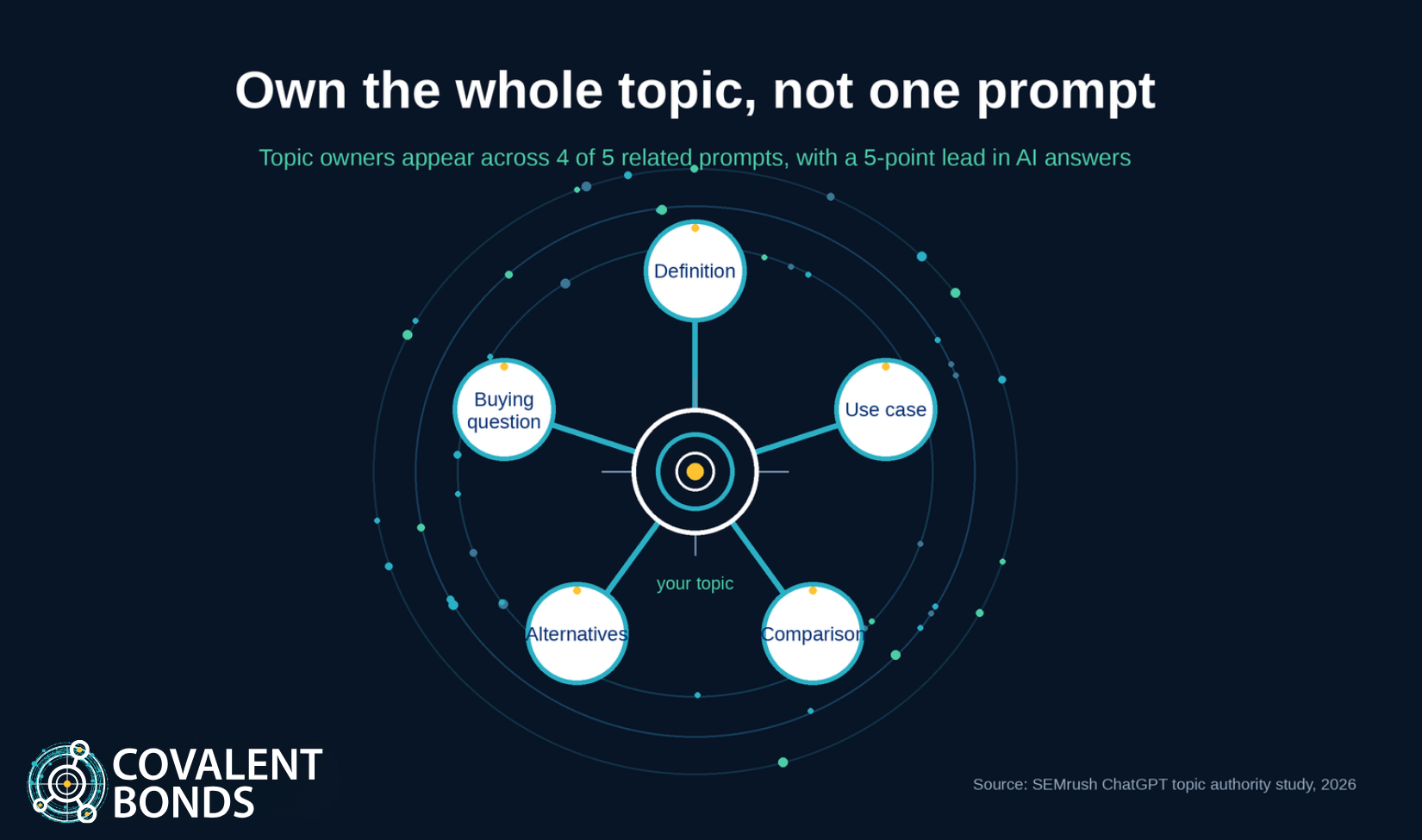
The most important shift in AI search strategy is moving from keyword targeting to Category Entry Points (CEPs): the specific buyer situations that trigger need for your category.
In scientific marketing, CEPs look like:
- "We need to accelerate characterization timelines without rebuilding our internal lab capacity."
- "Our regulatory submission requires independent analytical validation — where do we start?"
- "We're evaluating CRO partners for a first-in-class biologics program and don't know the criteria."
Semrush research on CEP-anchored content found that a single article built around a specific buyer situation generated consistent AI citations for over four months across ChatGPT, Google AI Overviews, and Google AI Mode — lifting brand share of voice in its topic cluster from 15% to 26% in one week post-publication.
The mechanism: AI agents match full buyer situations to content, not just keywords. Content anchored to the moment of need gets retrieved every time a buyer is in that moment — regardless of how they phrase it.
Immediate action: Map the 10–15 real moments that bring buyers into your category. Those are your content priorities for H2 2026.
Optimize for the AI Box — The 50-Word Answer That Drives Visibility
The AI Box (AI Overview or AI-generated answer) is where AI search tools place their synthesized response — above all other results, and increasingly the only result many buyers read.
Capturing the AI Box requires the Answer-First Model: a definitive, standalone answer in the first 50–70 words of every content piece. This is the section AI platforms scrape and surface when a buyer's query matches your content. Without it, even accurate, well-written content gets passed over.
For scientific brands, this is especially powerful for research-stage queries — questions buyers ask early in evaluation, like methodology comparisons, mechanism-of-action explainers, and category definitions.
Structure every content asset with:
- A 50–70 word answer nugget in the opening paragraph (optimized for AI Box capture)
- Scientific Nouns for research-focused pages — Characterization, Structure, Mechanism, Validation — signaling depth to both AI and human readers
- Action Verbs for commercial/operational pages — Accelerate, Optimize, Streamline — signaling applicability to buying decisions
- A Key Takeaways box at the top to facilitate scraping by Perplexity, SearchGPT, and Google AI Mode
Accelerate Algorithmic Trust with the Agentic Web Stack
Here's what most scientific marketers haven't fully internalized: bots now generate more web traffic than human users — and AI agents are the fastest-growing segment within that shift. While the 57% figure covers all automated traffic, AI agent traffic specifically grew nearly 8,000% throughout 2025 (HUMAN Security, 2026 State of AI Traffic). These aren't generic crawlers — they're tools like ChatGPT and Perplexity evaluating your brand on a buyer's behalf.
Your site now has two audiences: the scientists and procurement leads you've always written for, and the AI agents evaluating your brand on their behalf.
Optimizing for agentic traffic means building across five layers — from technical SEO foundations up through agentic protocols. For scientific brands, the most immediately actionable are:
Accelerate Agent Readiness — Structure pages so AI can parse your claims. Lead with clear, comparable facts: what you do, who you serve, what problem you solve. Avoid burying critical differentiators in PDFs or JavaScript that AI agents can't render.
Optimize Off-Site Presence — AI agents weigh third-party signals heavily. Inconsistent positioning across your website, G2, PubMed citations, conference proceedings, and partner profiles creates ambiguity — and agents default to clearer competitors. Audit every external mention of your brand for consistency.
Structure for Intent-Specific Definitions — Every key page should open with the specific pain point it addresses, e.g., "Highly sensitive characterization without sample consumption" rather than a generic capabilities overview.
[Beyond your on-site content (link to content strategy), your off-site digital footprint signals authority to the AI platforms doing the shortlisting for your buyers.]
Measuring What Matters Now: AI Visibility, Not Just Rankings
The metrics that defined SEO success in 2024 are incomplete in 2026. Scientific marketers now need to track alongside traditional KPIs:
- AI Citations — How often does your content appear as a source in AI-generated answers?
- Brand Mentions in AI answers — Does your name appear in the synthesized response itself, not just the footnotes?
- AI Share of Voice — What percentage of AI answers in your category include your brand vs. competitors?
- AI-referred sessions — Traffic from ChatGPT, Perplexity, Gemini, and Google AI Mode, trackable via GA4 custom segments.
Scientific buyers who arrive via an AI recommendation have already been pre-qualified — the AI agent matched them to your solution before they ever clicked. That pre-qualification is reflected in the 4.4× conversion value Semrush attributes to AI-referred traffic.
Frequently Asked Questions
What is AEO, and how is it different from SEO? SEO optimizes your content to rank in traditional search engine results pages. AEO (Answer Engine Optimization) optimizes your content to be cited as the authoritative source inside AI-generated answers — on platforms like ChatGPT, Perplexity, and Google AI Mode. In scientific marketing, the distinction matters because your buyers increasingly start their research with AI, not Google. AEO ensures your brand is the answer they receive, not just a result they might scroll to.
What is a "Ghost Town" in AI search? A Ghost Town is a topic or buyer question where your competitors are being cited by AI platforms and your brand is absent — even if you have relevant content on your website. Ghost Towns are typically caused by content that ranks well in traditional search but lacks the structured, answer-first formatting that AI agents need to extract and cite your expertise. Auditing your Ghost Towns is the first step in any AEO content strategy.
What is a Category Entry Point, and why does it matter for scientific content? A Category Entry Point (CEP) is the specific situation that triggers a buyer to need your category. In scientific marketing, a CEP might be: "We need to validate our analytical method before regulatory submission" or "We're scaling up a biologics program and evaluating external characterization partners." AI agents match buyer situations to content — not keywords. Content anchored to real CEPs gets cited consistently because it answers the actual moment of need.
How do I know if my brand is appearing in AI-generated answers? The clearest signals are AI citations (when your content is referenced as a source in an AI answer) and brand mentions (when your company name appears in the AI's response body). These are now trackable via tools like Semrush's AI Visibility Toolkit and GA4 custom segments filtering for referral traffic from ChatGPT, Gemini, and Perplexity. If you haven't set up AI visibility tracking, you're flying blind on a growing share of your buyers' research journey.
How quickly does bot traffic affect my scientific company if I don't optimize for it? The shift is already underway — and the part that matters most to scientific marketers isn't bots broadly, but AI agents specifically. Not all bots are AI agents: Googlebot, spam crawlers, and monitoring tools are bots too, and they account for much of the 57% of web traffic that is now automated (Cloudflare, June 2026). The relevant surge is within that figure: AI agent traffic — tools like ChatGPT, Perplexity, and Gemini that actively browse, evaluate, and shortlist vendors on a buyer's behalf — grew nearly 8,000% throughout 2025 (HUMAN Security). For scientific companies with long sales cycles and high-consideration buyers, that means AI agents are evaluating your content right now, before a single human visits your site. Every month without AEO-structured content is a month your competitors' content is training AI models ahead of yours.
What to Do This July
Your buyers are already asking AI agents which companies, tools, and methods best fit their research and procurement needs. The question is whether your content is positioned to be the answer those agents return.
Three priorities now:
1. Audit your Ghost Towns — Find the buyer questions in your category where AI answers currently cite competitors, not you. That gap is your content roadmap.
2. Anchor new content to Category Entry Points — Map real buyer situations and write directly to them, not to search volume.
3. Apply the Answer-First Model — Every content asset needs a 50–70 word definitive answer in the opening paragraph, plus a Key Takeaways box structured for AI scraping.
If you're ready to move from keyword-based content to AI-cited authority, our AI-Forward MarComs service combines AEO, Intent-Driven SEO, and Authority PR into a single Signal Capture architecture built for scientific brands.
Sources: Why category entry points belong in every AI search strategy (Semrush, June 2026) · How to optimize for the agentic web (Semrush, June 2026) · Bot traffic now exceeds traffic from human users (Semrush, June 2026) · 2026 State of AI Traffic (HUMAN Security)